Self Verification: Building a Cross-Country Security Layer
Industry
Digital Banking
Client
Nubank
Focus Area
Platform Design
Timeline
2023
Industry
Digital Banking
Client
Nubank
Focus Area
Platform Design
Timeline
2023
1. Overview
For years, phone authentication at Nubank relied heavily on manual questioning by agents. Customers were asked to confirm personal information while already stressed, frustrated, or dealing with urgent financial issues.
The process was slow, inconsistent, and increasingly vulnerable to fraud and social engineering. As call volumes grew across Latin America, manual verification became one of the most fragile parts of the support operation.
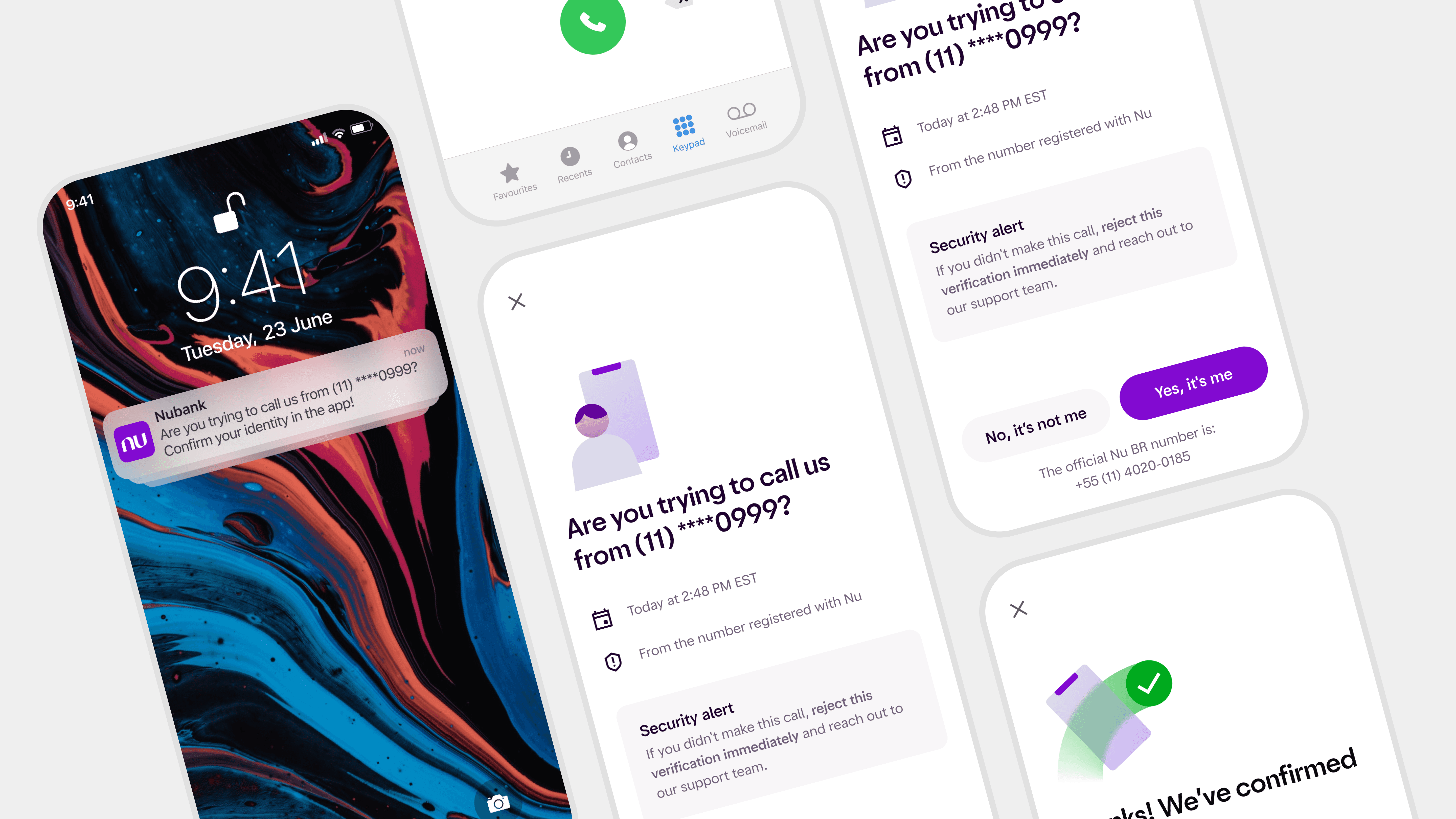
This case describes how we designed Self Verification: a secure, app-based identity layer that shifted authentication from human interrogation to digital confirmation, enabling scalable, multi-country verification infrastructure.
For years, phone authentication at Nubank relied heavily on manual questioning by agents. Customers were asked to confirm personal information while already stressed, frustrated, or dealing with urgent financial issues.
The process was slow, inconsistent, and increasingly vulnerable to fraud and social engineering. As call volumes grew across Latin America, manual verification became one of the most fragile parts of the support operation.
This case describes how we designed Self Verification: a secure, app-based identity layer that shifted authentication from human interrogation to digital confirmation, enabling scalable, multi-country verification infrastructure.
For years, phone authentication at Nubank relied heavily on manual questioning by agents. Customers were asked to confirm personal information while already stressed, frustrated, or dealing with urgent financial issues.
The process was slow, inconsistent, and increasingly vulnerable to fraud and social engineering. As call volumes grew across Latin America, manual verification became one of the most fragile parts of the support operation.
This case describes how we designed Self Verification: a secure, app-based identity layer that shifted authentication from human interrogation to digital confirmation, enabling scalable, multi-country verification infrastructure.
How do we move identity verification from fragile human processes to secure digital infrastructure across countries?
2. Strategic Context
As call volumes grew across Latin America, manual verification became one of the most fragile operational components. It generated:
High exposure of sensitive data
Long handling times (40–90s)
Inconsistent security standards
High training costs
Fraud vulnerability
Meanwhile, the Nubank app already supported secure authentication. The strategic opportunity was to extend this trust infrastructure to the phone channel.
As call volumes grew across Latin America, manual verification became one of the most fragile operational components. It generated:
High exposure of sensitive data
Long handling times (40–90s)
Inconsistent security standards
High training costs
Fraud vulnerability
Meanwhile, the Nubank app already supported secure authentication. The strategic opportunity was to extend this trust infrastructure to the phone channel.
As call volumes grew across Latin America, manual verification became one of the most fragile operational components. It generated:
High exposure of sensitive data
Long handling times (40–90s)
Inconsistent security standards
High training costs
Fraud vulnerability
Meanwhile, the Nubank app already supported secure authentication. The strategic opportunity was to extend this trust infrastructure to the phone channel.
3. Role & Scope
My central responsibility was ensuring that security improvements translated into usable, trustworthy experiences. Responsibilities:
Designing cross-channel authentication journeys
Defining interaction patterns between phone and app
Structuring experimentation frameworks
Coordinating with Fraud, Risk, Legal, and Engineering
Adapting flows for Brazil, Mexico, and Colombia
Establishing success and guardrail metrics
My central responsibility was ensuring that security improvements translated into usable, trustworthy experiences. Responsibilities:
Designing cross-channel authentication journeys
Defining interaction patterns between phone and app
Structuring experimentation frameworks
Coordinating with Fraud, Risk, Legal, and Engineering
Adapting flows for Brazil, Mexico, and Colombia
Establishing success and guardrail metrics
My central responsibility was ensuring that security improvements translated into usable, trustworthy experiences. Responsibilities:
Designing cross-channel authentication journeys
Defining interaction patterns between phone and app
Structuring experimentation frameworks
Coordinating with Fraud, Risk, Legal, and Engineering
Adapting flows for Brazil, Mexico, and Colombia
Establishing success and guardrail metrics
“He designed verification systems that were intuitive for both customers and operations teams, reducing training needs and increasing security.”
Operations Manager
5. Trade-offs & Decisions
Security vs Accessibility
Digital-first verification improved security but risked excluding users without reliable app access. Overly strict enforcement would increase abandonment. We designed structured fallback routes to balance protection and inclusion.
Critical Trade-offs
Digital-first vs Inclusivity
Speed vs Fraud Resistance
Standardization vs Localization
Missteps & Corrections
Early MVPs showed low engagement and confusion around instructions.
We redesigned prompts, simplified flows, and adjusted timing.
Regional friction required further adaptation.
Security vs Accessibility
Digital-first verification improved security but risked excluding users without reliable app access. Overly strict enforcement would increase abandonment. We designed structured fallback routes to balance protection and inclusion.
Critical Trade-offs
Digital-first vs Inclusivity
Speed vs Fraud Resistance
Standardization vs Localization
Missteps & Corrections
Early MVPs showed low engagement and confusion around instructions.
We redesigned prompts, simplified flows, and adjusted timing.
Regional friction required further adaptation.
Security vs Accessibility
Digital-first verification improved security but risked excluding users without reliable app access. Overly strict enforcement would increase abandonment. We designed structured fallback routes to balance protection and inclusion.
Critical Trade-offs
Digital-first vs Inclusivity
Speed vs Fraud Resistance
Standardization vs Localization
Missteps & Corrections
Early MVPs showed low engagement and confusion around instructions.
We redesigned prompts, simplified flows, and adjusted timing.
Regional friction required further adaptation.

7. Experimentation
From MVP to maturity
We launched Self Verification through successive experimental phases.
MVP: BrazilInitial pilots focused on validating behavioral adoption. Results:
~30% engagement
No negative impact on satisfaction
18-second average handling time reduction
R$2.6M annual savings potential
These signals justified national rollout.
V1: Security stress tests
As adoption grew, we expanded challenge mechanisms and stress-tested fraud resilience. Initial results revealed increased friction and drop-offs. Rather than abandoning the system, we redesigned interaction pacing and fallback logic.
V2: Engagement optimization
Engagement plateaued around 34%. We ran multi-armed experiments testing:
Announcement framing
Audio scripts
Fallback timing
Automatic drop logic
Best-performing variants increased engagement by more than 10 percentage points.
Multi-country expansion: Designing for regulation
Scaling to Mexico and Colombia introduced new regulatory constraints. Mexican regulations required stronger authentication categories and additional password-based validation.
We redesigned the platform to support country-specific rules without fragmenting the experience. This involved:
Localized scripts (Spanish and Portuguese)
Regulatory alignment
Market-specific fallback logic
Legal review cycles
The result was a reusable framework adaptable across geographies.
Content and voice design
Security experiences are strongly shaped by language. I led the definition of IVR scripts and in-app copy, balancing:
Authority
Emotional reassurance
Actionability
Cultural adaptation
Standardized voice and screen systems reduced confusion and increased compliance.
From MVP to maturity
We launched Self Verification through successive experimental phases.
MVP: BrazilInitial pilots focused on validating behavioral adoption. Results:
~30% engagement
No negative impact on satisfaction
18-second average handling time reduction
R$2.6M annual savings potential
These signals justified national rollout.
V1: Security stress tests
As adoption grew, we expanded challenge mechanisms and stress-tested fraud resilience. Initial results revealed increased friction and drop-offs. Rather than abandoning the system, we redesigned interaction pacing and fallback logic.
V2: Engagement optimization
Engagement plateaued around 34%. We ran multi-armed experiments testing:
Announcement framing
Audio scripts
Fallback timing
Automatic drop logic
Best-performing variants increased engagement by more than 10 percentage points.
Multi-country expansion: Designing for regulation
Scaling to Mexico and Colombia introduced new regulatory constraints. Mexican regulations required stronger authentication categories and additional password-based validation.
We redesigned the platform to support country-specific rules without fragmenting the experience. This involved:
Localized scripts (Spanish and Portuguese)
Regulatory alignment
Market-specific fallback logic
Legal review cycles
The result was a reusable framework adaptable across geographies.
Content and voice design
Security experiences are strongly shaped by language. I led the definition of IVR scripts and in-app copy, balancing:
Authority
Emotional reassurance
Actionability
Cultural adaptation
Standardized voice and screen systems reduced confusion and increased compliance.
From MVP to maturity
We launched Self Verification through successive experimental phases.
MVP: BrazilInitial pilots focused on validating behavioral adoption. Results:
~30% engagement
No negative impact on satisfaction
18-second average handling time reduction
R$2.6M annual savings potential
These signals justified national rollout.
V1: Security stress tests
As adoption grew, we expanded challenge mechanisms and stress-tested fraud resilience. Initial results revealed increased friction and drop-offs. Rather than abandoning the system, we redesigned interaction pacing and fallback logic.
V2: Engagement optimization
Engagement plateaued around 34%. We ran multi-armed experiments testing:
Announcement framing
Audio scripts
Fallback timing
Automatic drop logic
Best-performing variants increased engagement by more than 10 percentage points.
Multi-country expansion: Designing for regulation
Scaling to Mexico and Colombia introduced new regulatory constraints. Mexican regulations required stronger authentication categories and additional password-based validation.
We redesigned the platform to support country-specific rules without fragmenting the experience. This involved:
Localized scripts (Spanish and Portuguese)
Regulatory alignment
Market-specific fallback logic
Legal review cycles
The result was a reusable framework adaptable across geographies.
Content and voice design
Security experiences are strongly shaped by language. I led the definition of IVR scripts and in-app copy, balancing:
Authority
Emotional reassurance
Actionability
Cultural adaptation
Standardized voice and screen systems reduced confusion and increased compliance.
8. Impact
At maturity, Self Verification became foundational infrastructure. Key outcomes:
Millions of automated verifications
Multi-country deployment
Significant reduction in manual questioning
Lower fraud exposure
Multi-million BRL operational savings
Reduced average handling time across priority flows
Verification evolved from cost center to efficiency lever.
At maturity, Self Verification became foundational infrastructure. Key outcomes:
Millions of automated verifications
Multi-country deployment
Significant reduction in manual questioning
Lower fraud exposure
Multi-million BRL operational savings
Reduced average handling time across priority flows
Verification evolved from cost center to efficiency lever.
At maturity, Self Verification became foundational infrastructure. Key outcomes:
Millions of automated verifications
Multi-country deployment
Significant reduction in manual questioning
Lower fraud exposure
Multi-million BRL operational savings
Reduced average handling time across priority flows
Verification evolved from cost center to efficiency lever.