AI Conversational Partner: From Vision to Infrastructure

Industry

Digital Banking

Client

Nubank

Focus Area

AI Systems

Timeline

2025

Industry

Digital Banking

Client

Nubank

Focus Area

AI Systems

Timeline

2025

1. Overview

By 2025, Nubank’s conversational ecosystem had reached an inflection point.

Chat support, Pix automation, insights surfaces, and emerging AI features were evolving independently. Each initiative solved a local problem, but together they formed a fragmented landscape: multiple entry points, inconsistent behaviors, duplicated patterns, and unclear ownership.

At the same time, Nubank’s AI ambitions were accelerating. The company launched the Private Banker initiative to define the future of AI as a consumer-facing financial partner, unifying assistance, advice, and support into a single conversational layer.

I was one of four designers selected for the cross-functional taskforce responsible for shaping that long-term vision. After presenting the strategy to executive leadership in Q3 2025, the proposal was not only approved, it was accelerated.

This case describes how we translated vision into platform foundations.

By 2025, Nubank’s conversational ecosystem had reached an inflection point.

Chat support, Pix automation, insights surfaces, and emerging AI features were evolving independently. Each initiative solved a local problem, but together they formed a fragmented landscape: multiple entry points, inconsistent behaviors, duplicated patterns, and unclear ownership.

At the same time, Nubank’s AI ambitions were accelerating. The company launched the Private Banker initiative to define the future of AI as a consumer-facing financial partner, unifying assistance, advice, and support into a single conversational layer.

I was one of four designers selected for the cross-functional taskforce responsible for shaping that long-term vision. After presenting the strategy to executive leadership in Q3 2025, the proposal was not only approved, it was accelerated.

This case describes how we translated vision into platform foundations.

By 2025, Nubank’s conversational ecosystem had reached an inflection point.

Chat support, Pix automation, insights surfaces, and emerging AI features were evolving independently. Each initiative solved a local problem, but together they formed a fragmented landscape: multiple entry points, inconsistent behaviors, duplicated patterns, and unclear ownership.

At the same time, Nubank’s AI ambitions were accelerating. The company launched the Private Banker initiative to define the future of AI as a consumer-facing financial partner, unifying assistance, advice, and support into a single conversational layer.

I was one of four designers selected for the cross-functional taskforce responsible for shaping that long-term vision. After presenting the strategy to executive leadership in Q3 2025, the proposal was not only approved, it was accelerated.

This case describes how we translated vision into platform foundations.

How do we transform fragmented conversational features into a unified AI platform to be adopted company-wide?

2. Strategic Context

Before Private Banker, Nubank’s conversational touchpoints were growing organically:

  • Support chat flows

  • AI-powered Pix journeys

  • Insights experiences

  • Domain-specific conversational tools

From a user perspective, this created friction:

  • Inconsistent interaction patterns

  • Confusion about capabilities

  • Disjointed escalation paths

  • Redundant conversational structures

From an organizational perspective, it created design debt and slowed AI expansion.
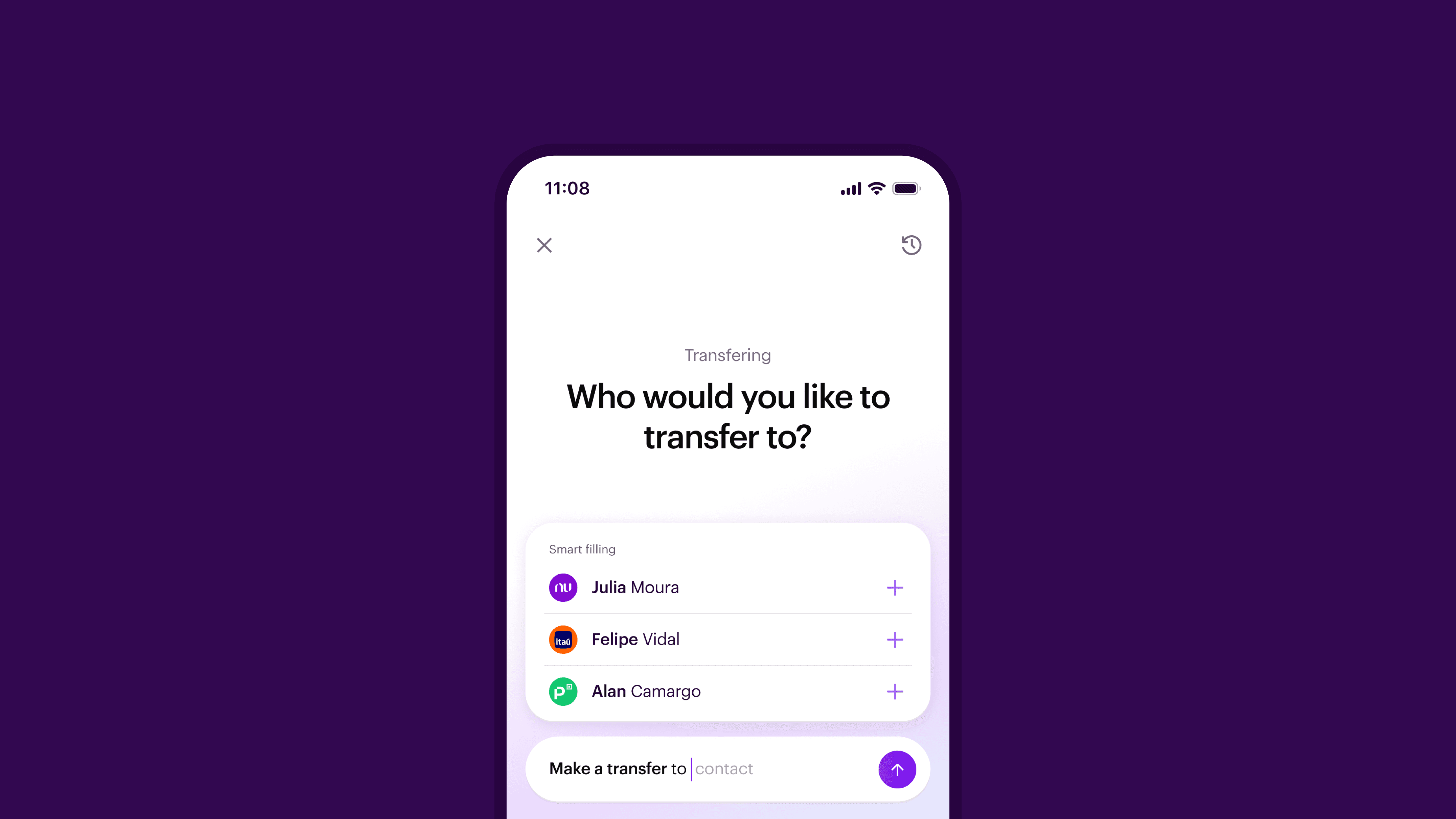
Before Private Banker, Nubank’s conversational touchpoints were growing organically:

  • Support chat flows

  • AI-powered Pix journeys

  • Insights experiences

  • Domain-specific conversational tools

From a user perspective, this created friction:

  • Inconsistent interaction patterns

  • Confusion about capabilities

  • Disjointed escalation paths

  • Redundant conversational structures

From an organizational perspective, it created design debt and slowed AI expansion.

Before Private Banker, Nubank’s conversational touchpoints were growing organically:

  • Support chat flows

  • AI-powered Pix journeys

  • Insights experiences

  • Domain-specific conversational tools

From a user perspective, this created friction:

  • Inconsistent interaction patterns

  • Confusion about capabilities

  • Disjointed escalation paths

  • Redundant conversational structures

From an organizational perspective, it created design debt and slowed AI expansion.

3. Role & Scope

I was one of four designers in the taskforce and became a primary contributor to the foundational layer. My scope included:

  • Vision articulation

  • Platform primitives

  • Conversation stages

  • Governance models

  • Cross-BU collaboration

I was one of four designers in the taskforce and became a primary contributor to the foundational layer. My scope included:

  • Vision articulation

  • Platform primitives

  • Conversation stages

  • Governance models

  • Cross-BU collaboration

I was one of four designers in the taskforce and became a primary contributor to the foundational layer. My scope included:

  • Vision articulation

  • Platform primitives

  • Conversation stages

  • Governance models

  • Cross-BU collaboration

4.Design Workflow

4. Design Workflow

  1. Phase 1: Defining the vision

    As part of the taskforce, I collaborated on defining Private Banker’s long-term role. We articulated the assistant as operating across three dimensions:

    • Support (resolving issues)

    • Assistant (executing actions)

    • Advisor (providing contextual financial intelligence)

    We mapped multimodal journeys that integrated:

    • Conversational UI

    • Embedded widgets

    • Actionable components

    • Escalation logic

    The vision was presented to executive leadership and widely adopted across business units.


  2. Phase 2: From vision to infrastructure

    Once accelerated, the challenge shifted. We now had to translate a 12–18 month vision into near-term deliverables while preserving architectural integrity. I became one of the primary designers shaping the foundational layer of the conversation platform. Responsibilities:

    • Defining reusable building blocks

    • Standardizing conversation stages

    • Designing cross-agent patterns

    • Establishing governance frameworks

    • Collaborating with engineering on platform abstractions

    • Influencing prioritization across business units

    The goal was to prevent fragmentation while enabling scale.


    Designing the conversation building blocks

    We decomposed conversation into standardized stages:

    • Pre-resolution (intent capture and framing)

    • Resolution (execution and information delivery)

    • Evaluation (closure and feedback)

    We defined shared interaction types:

    • Free-form text

    • Structured widgets

    • Embedded actions

    • Navigation links

    Session rules:

    • Single active conversation

    • Controlled reopening

    • Structured termination

    These abstractions ensured consistency across all agents built on the platform. Rather than designing flows per feature, we designed primitives.


    Multi-agent architecture and governance

    Private Banker relied on a multi-agent architecture, where specialized agents (Pix, Support Evaluation, Open Finance, etc.) operated under a unified conversational layer. Without governance, this architecture would fragment quickly. We established:

    • Routing logic standards

    • Escalation protocols

    • Intent disambiguation rules

    • Failure handling patterns

    • Tone and language guidelines

    I collaborated directly on use cases with domain teams, ensuring that each new agent respected platform constraints.


    Tone, trust, and financial intelligence

    Because Private Banker positioned itself as a financial partner, tone carried strategic weight. In collaboration with content and brand teams, we defined a tone-of-voice framework centered on:

    • Clarity without condescension

    • Proactivity without intrusion

    • Authority without rigidity

    • Empathy without overfamiliarity

    These standards were documented and required for any new conversational initiative.

  1. Phase 1: Defining the vision

    As part of the taskforce, I collaborated on defining Private Banker’s long-term role. We articulated the assistant as operating across three dimensions:

    • Support (resolving issues)

    • Assistant (executing actions)

    • Advisor (providing contextual financial intelligence)

    We mapped multimodal journeys that integrated:

    • Conversational UI

    • Embedded widgets

    • Actionable components

    • Escalation logic

    The vision was presented to executive leadership and widely adopted across business units.


  2. Phase 2: From vision to infrastructure

    Once accelerated, the challenge shifted. We now had to translate a 12–18 month vision into near-term deliverables while preserving architectural integrity. I became one of the primary designers shaping the foundational layer of the conversation platform. Responsibilities:

    • Defining reusable building blocks

    • Standardizing conversation stages

    • Designing cross-agent patterns

    • Establishing governance frameworks

    • Collaborating with engineering on platform abstractions

    • Influencing prioritization across business units

    The goal was to prevent fragmentation while enabling scale.


    Designing the conversation building blocks

    We decomposed conversation into standardized stages:

    • Pre-resolution (intent capture and framing)

    • Resolution (execution and information delivery)

    • Evaluation (closure and feedback)

    We defined shared interaction types:

    • Free-form text

    • Structured widgets

    • Embedded actions

    • Navigation links

    Session rules:

    • Single active conversation

    • Controlled reopening

    • Structured termination

    These abstractions ensured consistency across all agents built on the platform. Rather than designing flows per feature, we designed primitives.


    Multi-agent architecture and governance

    Private Banker relied on a multi-agent architecture, where specialized agents (Pix, Support Evaluation, Open Finance, etc.) operated under a unified conversational layer. Without governance, this architecture would fragment quickly. We established:

    • Routing logic standards

    • Escalation protocols

    • Intent disambiguation rules

    • Failure handling patterns

    • Tone and language guidelines

    I collaborated directly on use cases with domain teams, ensuring that each new agent respected platform constraints.


    Tone, trust, and financial intelligence

    Because Private Banker positioned itself as a financial partner, tone carried strategic weight. In collaboration with content and brand teams, we defined a tone-of-voice framework centered on:

    • Clarity without condescension

    • Proactivity without intrusion

    • Authority without rigidity

    • Empathy without overfamiliarity

    These standards were documented and required for any new conversational initiative.

  1. Phase 1: Defining the vision

    As part of the taskforce, I collaborated on defining Private Banker’s long-term role. We articulated the assistant as operating across three dimensions:

    • Support (resolving issues)

    • Assistant (executing actions)

    • Advisor (providing contextual financial intelligence)

    We mapped multimodal journeys that integrated:

    • Conversational UI

    • Embedded widgets

    • Actionable components

    • Escalation logic

    The vision was presented to executive leadership and widely adopted across business units.


  2. Phase 2: From vision to infrastructure

    Once accelerated, the challenge shifted. We now had to translate a 12–18 month vision into near-term deliverables while preserving architectural integrity. I became one of the primary designers shaping the foundational layer of the conversation platform. Responsibilities:

    • Defining reusable building blocks

    • Standardizing conversation stages

    • Designing cross-agent patterns

    • Establishing governance frameworks

    • Collaborating with engineering on platform abstractions

    • Influencing prioritization across business units

    The goal was to prevent fragmentation while enabling scale.


    Designing the conversation building blocks

    We decomposed conversation into standardized stages:

    • Pre-resolution (intent capture and framing)

    • Resolution (execution and information delivery)

    • Evaluation (closure and feedback)

    We defined shared interaction types:

    • Free-form text

    • Structured widgets

    • Embedded actions

    • Navigation links

    Session rules:

    • Single active conversation

    • Controlled reopening

    • Structured termination

    These abstractions ensured consistency across all agents built on the platform. Rather than designing flows per feature, we designed primitives.


    Multi-agent architecture and governance

    Private Banker relied on a multi-agent architecture, where specialized agents (Pix, Support Evaluation, Open Finance, etc.) operated under a unified conversational layer. Without governance, this architecture would fragment quickly. We established:

    • Routing logic standards

    • Escalation protocols

    • Intent disambiguation rules

    • Failure handling patterns

    • Tone and language guidelines

    I collaborated directly on use cases with domain teams, ensuring that each new agent respected platform constraints.


    Tone, trust, and financial intelligence

    Because Private Banker positioned itself as a financial partner, tone carried strategic weight. In collaboration with content and brand teams, we defined a tone-of-voice framework centered on:

    • Clarity without condescension

    • Proactivity without intrusion

    • Authority without rigidity

    • Empathy without overfamiliarity

    These standards were documented and required for any new conversational initiative.

“He led ambiguous initiatives and translated vision into scalable experiences adopted across multiple products.”

Senior Product Manager

5. Trade-offs & Decisions

  1. Vision vs Feasibility

    After executive approval, the roadmap was accelerated so we had to translate a 12–18 month vision into near-term delivery without compromising architecture.


  2. Critical Trade-offs

    • Speed vs Architectural Integrity

    • Customization vs Standardization

    • Autonomy vs Central Governance


  3. Missteps & Corrections

    Early abstractions left ownership gaps and duplicated logic then we clarified governance and documentation.

  1. Vision vs Feasibility

    After executive approval, the roadmap was accelerated so we had to translate a 12–18 month vision into near-term delivery without compromising architecture.


  2. Critical Trade-offs

    • Speed vs Architectural Integrity

    • Customization vs Standardization

    • Autonomy vs Central Governance


  3. Missteps & Corrections

    Early abstractions left ownership gaps and duplicated logic then we clarified governance and documentation.

  1. Vision vs Feasibility

    After executive approval, the roadmap was accelerated so we had to translate a 12–18 month vision into near-term delivery without compromising architecture.


  2. Critical Trade-offs

    • Speed vs Architectural Integrity

    • Customization vs Standardization

    • Autonomy vs Central Governance


  3. Missteps & Corrections

    Early abstractions left ownership gaps and duplicated logic then we clarified governance and documentation.

7. Experimentation

  1. Accelerating the roadmap: P0 and P1

    To balance ambition and feasibility, we structured delivery into phases:

    • P0: Foundational infrastructure

    • P1: Core agents and high-priority journeys

    • P2+: Advanced personalization and advisory layers

    This roadmap allowed multiple BUs to contribute without compromising architectural coherence. The result was faster AI onboarding across teams and reduced duplication of effort.

  1. Accelerating the roadmap: P0 and P1

    To balance ambition and feasibility, we structured delivery into phases:

    • P0: Foundational infrastructure

    • P1: Core agents and high-priority journeys

    • P2+: Advanced personalization and advisory layers

    This roadmap allowed multiple BUs to contribute without compromising architectural coherence. The result was faster AI onboarding across teams and reduced duplication of effort.

  1. Accelerating the roadmap: P0 and P1

    To balance ambition and feasibility, we structured delivery into phases:

    • P0: Foundational infrastructure

    • P1: Core agents and high-priority journeys

    • P2+: Advanced personalization and advisory layers

    This roadmap allowed multiple BUs to contribute without compromising architectural coherence. The result was faster AI onboarding across teams and reduced duplication of effort.

8. Impact

Private Banker changed how teams approached conversation design. Instead of asking, “Can this feature use chat?”, teams began asking, “How does this integrate into the platform?”. Outcomes included:

  • Reduced design fragmentation

  • Accelerated AI experimentation

  • Improved cross-BU collaboration

  • Created a shared language around conversation design

  • Established reusable standards adopted company-wide

The platform became the reference architecture for conversational products.

Private Banker changed how teams approached conversation design. Instead of asking, “Can this feature use chat?”, teams began asking, “How does this integrate into the platform?”. Outcomes included:

  • Reduced design fragmentation

  • Accelerated AI experimentation

  • Improved cross-BU collaboration

  • Created a shared language around conversation design

  • Established reusable standards adopted company-wide

The platform became the reference architecture for conversational products.

Private Banker changed how teams approached conversation design. Instead of asking, “Can this feature use chat?”, teams began asking, “How does this integrate into the platform?”. Outcomes included:

  • Reduced design fragmentation

  • Accelerated AI experimentation

  • Improved cross-BU collaboration

  • Created a shared language around conversation design

  • Established reusable standards adopted company-wide

The platform became the reference architecture for conversational products.